Helio Ocean
Helio Ocean repurposes Helio's industrial IoT observability engine — heterogeneous ingestion, normalization, AI-assisted analysis, live visualization — for ocean plastic waste monitoring. It is a spec-driven proof of concept exploring a parallel pivot: Helio keeps selling to manufacturers while this workstream validates that the engine transfers.
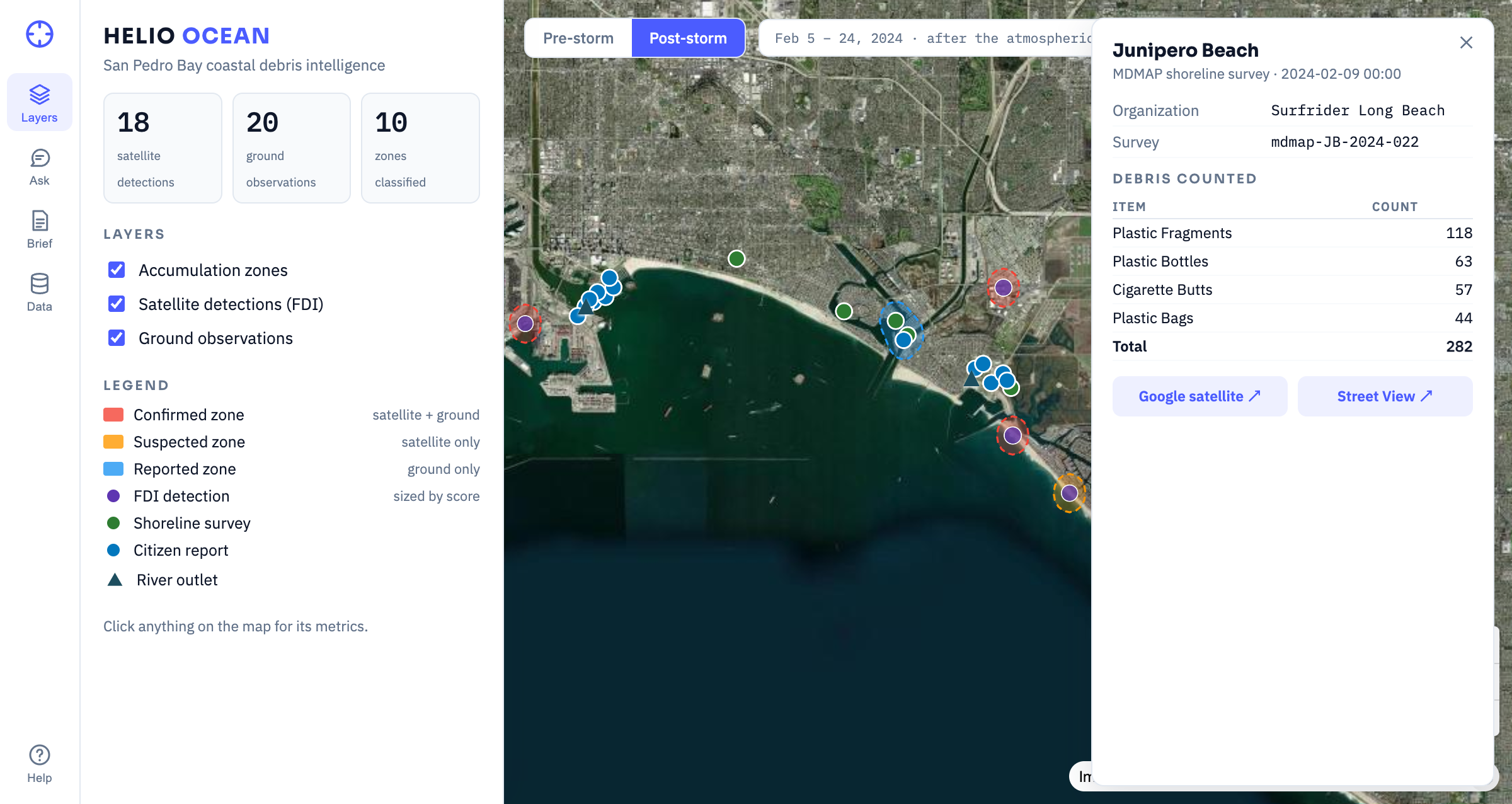
Anchor use case: the Southern California coast — LA River and San Gabriel River outlets into San Pedro Bay / Long Beach — comparing the windows before and after the February 2024 atmospheric river storms.
The system in one diagram
What works today
| Capability | Status |
|---|---|
| Sentinel-2 Floating Debris Index detection | Live — real scenes from the public earth-search STAC API, no credentials |
| NOAA MDMAP + Debris Tracker ingestion | Fixtures in exact export formats; real exports drop into data/raw/ unchanged |
| Zone cross-referencing (confirmed / suspected / reported) | Working on live data |
| Map app with satellite basemap, feature metrics, detail panel | Working |
| "Ask the Ocean" natural-language queries | Live — Claude via AWS Bedrock, labeled offline fallback |
| Auto-generated post-storm briefing (markdown + PDF) | Working |
Where to go next
- Product Requirements — why the pivot is viable, users, architecture, risks
- MVP Roadmap — milestones M0–M3 and the post-MVP backlog
- User Stories — personas, epics, and the story map
- Feature Specs — FS-1..FS-8 with acceptance criteria (the contract the code is tested against)
- Traceability Matrix — every acceptance criterion mapped to its test and verification status
- Runbook — how to run the pipeline, app, tests, and doc tooling